
Redefining Secondary Education: CBSE's Two-Tier System for Science and Social Science
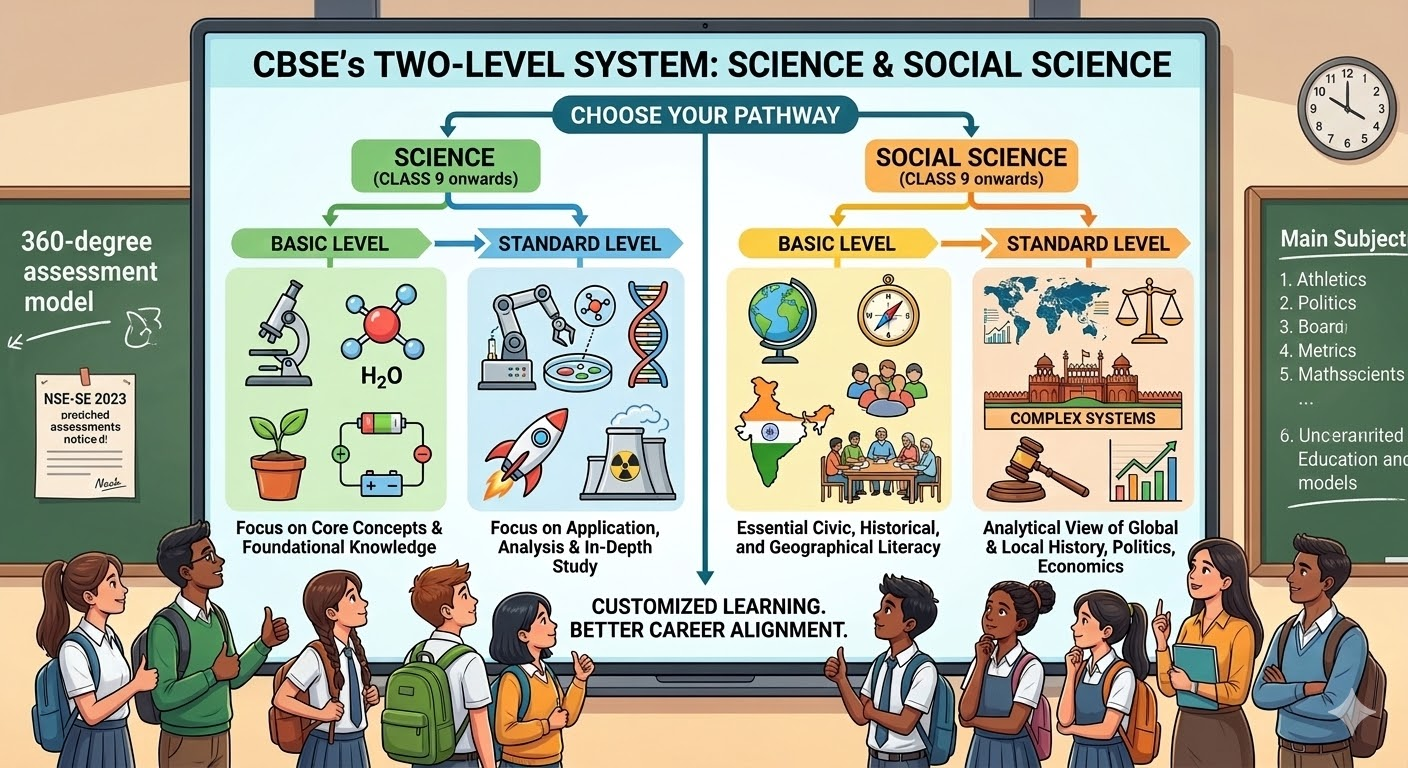
The Central Board of Secondary Education (CBSE) is taking a monumental step towards personalized learning by expanding its two-tier examination system. Following the successful implementation of its dual-level Mathematics curriculum, the Board has officially approved a similar structure for Science and Social Science.
Starting from the 2026-27 academic session for Class 9, students will have the flexibility to choose between two levels of difficulty—commonly referred to as Standard and Advanced (or Basic and Standard)—for these core subjects.
Here is a comprehensive breakdown of what this major policy shift means for students, parents, and the future of secondary education in India.
The Philosophy: Aligning with NEP 2020
This significant reform is a direct outcome of the National Education Policy (NEP) 2020, which advocates for a more flexible, student-centric approach to education. The traditional "one-size-fits-all" model often forces students to grapple with advanced concepts in subjects they have no intention of pursuing in higher education, leading to unnecessary academic stress.
The core objectives of this split are:
Stress Reduction: Allowing students to study subjects at a difficulty level that matches their aptitude.
Competency-Based Learning: Shifting the focus from rote memorization to assessing core capacities and practical understanding.
Career Alignment: Enabling students to build a stronger foundation in the subjects that align with their future career aspirations.
How the Two-Tier System Will Work
While the exact logistical framework is being finalized alongside the new NCERT textbooks, the operational structure of the dual-level system is becoming clear.
1. Curriculum and Textbooks
Unlike completely different subjects, both levels will share a common core syllabus. However, the depth of study will vary. The National Council of Educational Research and Training (NCERT) is developing new textbooks that will feature a common foundational section for all students, with supplementary modules or an additional section specifically meant for those opting for the Advanced level.
2. Examination Structure
The difference between the two tiers will be most visible during the board exams:
Standard Level: The question paper will focus on foundational knowledge, basic concepts, and straightforward applications. It is designed to be highly accessible and tests the mandatory core competencies required for a general understanding of the world.
Advanced Level: Students will tackle a more rigorous question paper (or an additional supplementary paper) that includes complex, application-based questions and Higher Order Thinking Skills (HOTS).
Making the Right Choice: Standard vs. Advanced
The decision to choose between the two levels in Class 9 will directly influence a student's academic trajectory in Classes 11 and 12.
Science
Opt for Advanced Science if: The student plans to pursue the Science stream (PCM/PCB) in Class 11 and is aiming for careers in Engineering, Medicine, Research, or Technology.
Opt for Standard Science if: The student finds Science challenging or plans to pursue Commerce, Humanities, or vocational courses where advanced scientific theories are not a prerequisite.
Social Science
Opt for Advanced Social Science if: The student wishes to take up Humanities/Arts in higher secondary, or is aiming for careers in Law, Civil Services, Journalism, or Social Work.
Opt for Standard Social Science if: The student intends to shift to the STEM or Commerce streams and prefers a simplified curriculum focusing only on essential civic, historical, and geographical literacy.
Important Note: To ensure flexibility, CBSE is expected to provide a designated window during the academic year for students to switch between levels if they find their initial choice unsuitable. Furthermore, similar to the Mathematics model, students who pass the Standard level but later wish to upgrade may have the option to appear for an improvement exam at the Advanced level.
Implementation Timeline
The rollout of this new structure is designed to be gradual, giving schools and students ample time to adapt:
| Academic Year | Milestone |
|---|---|
| 2025-26 | NCERT finalizes and releases new textbooks incorporating the dual-level content structure. Schools begin teacher training for differentiated instruction. |
| 2026-27 | Official Launch: The two-tier system is formally introduced for Class 9 students. |
| 2027-28 | First Board Exams: The first batch of Class 10 students will appear for the CBSE Board Exams under the new Standard/Advanced structure for Science and Social Science. |
Conclusion
The splitting of Science and Social Science into two difficulty levels is a progressive leap toward an inclusive education system. By acknowledging that every student has a unique academic fingerprint, CBSE is empowering learners to take charge of their educational journeys, study at their own pace, and prepare effectively for their chosen futures.
- Log in to post comments